

In 1948, two college-aged friends bought a pair of falcons and began to train them by shooting pieces of meat in the air using homemade slingshots that they made themselves. According to Tim Walsh, author of Wham-O Super Book, a man watching the guys was impressed and asked the guys where they got their slingshots from. On that day, Richard Knerr and Arthur “Spud” Melin had an epiphany. They went to their nearest Sears store, bought a band saw, set up shop in Knerr’s parent’s garage and got into the slingshot business. The name of the company? Wham-O.

Since that time, the company has created some 200 unique items, some more successful than others. In the early day, the company made their own versions of outdoor “toys” that would never fly today. Long gone are the Apache Throwing Tomahawk (“An ancient Indian weapon for killing game.”), the Borneo Hunting Blowgun (“Kills without poison.”) and the Throwing Dagger (“A powerful, silent weapon that splits 1” board at 30 ft.). Fortunately, the duo turned their sights on sports, games and novelty products.
Richard and Spud never really grew up and for over 75 years, Wham-O has continued to create some of the most iconic summer-time toys. Many of these toys are still popular today and have some crazy backstories.

1957: Frisbee
Despite what you may have heard, Wham-O didn’t invent the Frisbee. That honor went to Walter Fredick Morrison who enjoyed tossing things. In the 1930’s, his family would toss around a popcorn can lid back and forth. He got inspired when he and his girlfriend were tossing a round cake pan on the beach. Watching them play, a man offered Walter 25 cents for the five-cent pan. He had the start of a new business. But those plans had to be put on hold.
Walter left to serve in the Army Air Force during World War II and even became a prisoner of war, but when he got back home, he was ready to sell more flying discs.
In 1948, Walter designed the “Flyin’-Saucer” made of plastic and in 1955 he improved it calling it the Pluto Platter. Wham-O swooped in and bought the rights. But college students were still tossing kitchenware. They would toss pie plates from the Frisbie’s Pie Company. Wham-O then changed the name of Morrison’s platter to the Frisbee.

1961: Slip n’ Slide
Mike Carrier was a little dare devil. During the summer in 1960, he and his friends would water down his family’s painted concrete driveway, kick off their shoes, run and slide across the driveway barefoot. When his family moved, the Carriers’ backyard had a painted patio that worked just as well. That is until Mike went a little too far and crashed into a gate and broke it. Seeing that there was no stopping his son, Robert Carrier came up with a better idea.
According to Mental Floss, Robert was an upholster working on car seats made from Naugahyde. He bought a roll of the material and took it home. Out in the yard, he folded it over on one side and sewed it together leaving gaps. Then when he poked the garden hose through it, he created the very first Slip N’ Slide – a name he came up with himself. He took his invention to Wham-O and the rest is history.
While the Slip N’ Slide is fairly safe for children, accidents do happen. And usually, they happen to the kids’ parents. The warning on the backyard toy states that it is intended for children under the age of 11. Although rare, there had been reports of adults receiving some terrible neck injuries. By the late 1970’s, Wham-O took the product off the market. Since then, the product has come and gone but is still the culprit for various injuries. So, stay off the slide, dad!

1962: Water Wiggle
Richard Kneer designed the “wild action water hose” toy known as the Water Wiggle in 1962 and it became popular fast. There isn’t much to it – just a seven-foot-long hose with water-jet nozzle on the end and bell-shaped plastic cup with a silly face covering the end. Turn on the water and the little guy goes crazy randomly spraying water across the lawn.
Tragically though, two children died because of the little monster in 1975 and 1978 when the bell cover came off. Wham-O responded by voluntarily recalling the product.
Though Retroist called the toy, “The wet dance of doom”, in 2008, the toy did come back and is still sold today made with higher safety standards.

1963: Hula Hoop
Children have been rolling hoops for recreation for thousands of years, so concept wasn’t new when Wham-O began selling Hula Hoops. The toy company was not the first company to produce these rings that were made for kids to roll around their middles. They didn’t even come up with the name! However, Richard and Spud found a way to make their version stand among the crowd.
In 1963, Wham-O received a trademark for the first plastic hoop toy to feature the “shoop shoop” sound, thanks to a ball bearing placed inside.
Twenty million hoops were sold in the first six months of production. It was a big hit world-wide except for Japan who thought it incited improprieties and Russia who thought it was an example of the “emptiness of American culture.”

1966: Super Ball
The Super Ball was invented by Chemist Norman Stingley who made the ball out of Zectron. With similar qualities found in the fictional product Flubber (from Disney’s The Absent-Minded Professor), the Super Ball has an amazing bounce that seemingly can go on forever before it finds its way stuck under the refrigerator in the kitchen. (That’s where mine always wound up.)
Stingley first offered his invention to the Bettis Rubber Company, which he worked for, but they turned him down because it fell apart easily. Wham-O bought the invention, but according to Knerr, it took two years to perfect it. The company says that when dropped, each bounce is 92% as high as the bounce before it.
During its hey-day, Wham-O was able to produce 170,000 Super Balls per day. The “giant” Super Ball was created a few years later.
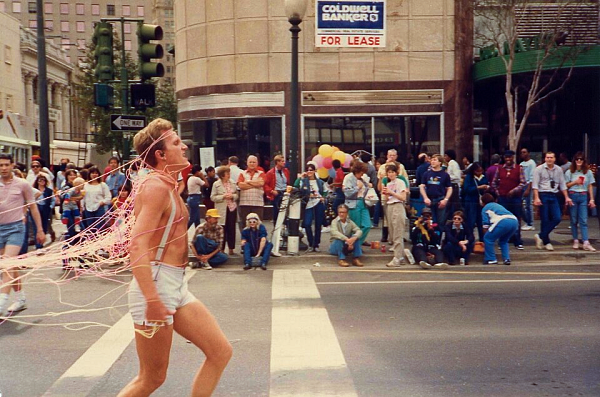
1972: Silly String
In 1972, Leonard A. Fish (an inventor) and Robert P. Cox (a chemist) received a patent for their invention for a “foamable resinous composition”. The pair had wanted the product to be used to create instant casts for broken or sprained arms and legs. Placed in an aerosol can, they tried out 500 different types of nozzles. By accident, they found one nozzle that created a whole different use for the goo.
The nozzle created a “string” that shot across the room and Fish decided that it would make for a great toy. The two set up an appointment with a Wham-O representative, but their presentation needed some work. During the meeting, Fish sprayed the “string” all over the man as well as his office. He was told to leave immediately.
However, the next day Fish got a telegram from that same employee. He asked Fish to send over two dozen cans of the stuff to test market the product.
Weirdly, today Silly String is made by the “Little Trees” Car-Freshner Corporation who bought the trademark.

1983: Hacky Sack
In 1972, Mike Marshall and John Stalberger invented “the original footbag” now known as the Hacky Sack. It is a small square-shaped beanbag that was originally filled with rice and glass buttons. Gameplay is like the Japanese game kemari and three other ones from South East Asia. The concept is simple but mastering the game takes some time. Players simply kick the Hacky Sack in the air trying to keep it from falling to the ground.
Sadly, Marshall passed away from a heart attack when he was just 28 years of age. Stalberger went on with the invention and founded the National Hacky Sack Company. As he traveled to schools all across Oregon state, the game grew in popularity. Stalberger sold the patent for the product to Wham-O in 1983 who say over 25 million footbags have been sold since that time.
Main Image: Brixiv/Pexels

Leave a comment